Car Diagnostic Scanner UK: What to Check Before You Buy
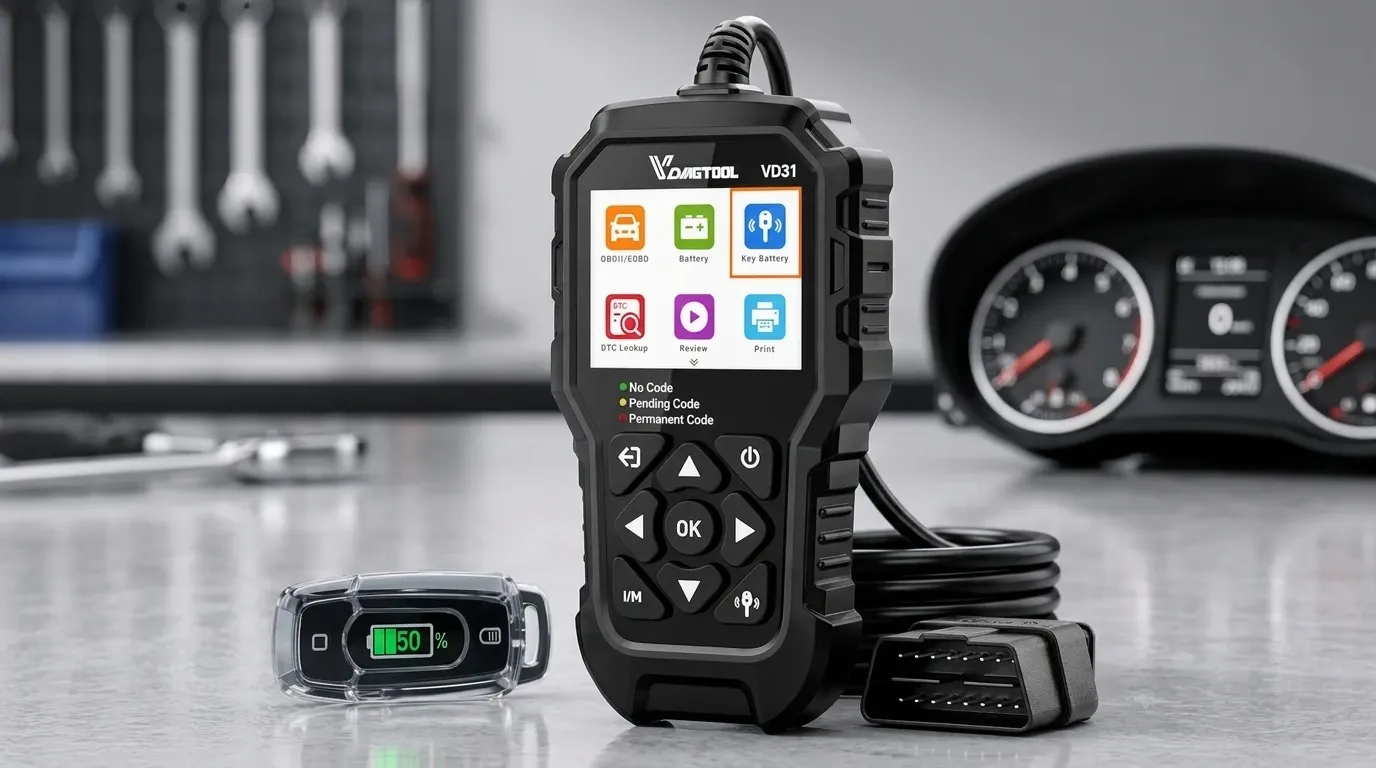
Short answer: a car diagnostic scanner UK motorists buy for home use should reliably read generic engine and emissions codes on their exact vehicle, preserve useful evidence and make its limits clear. It can give you a sensible first step before paying for diagnosis, but it cannot prove that a named component has failed or make a warning light safe to ignore.
If the cost of an initial code read feels frustrating, the useful question is not “which scanner has the longest feature list?” It is “which tool covers my car, gives me a result I can understand and tells me when to stop?”
What should a car diagnostic scanner cover?
For most private motorists, the baseline is generic OBD2/EOBD access to engine and emissions diagnostic trouble codes (DTCs). Helpful additions include pending codes, freeze-frame data captured when a fault was logged, live engine data and I/M readiness status. Those functions can narrow the next check without pretending to be a complete workshop diagnosis.
Generic OBD coverage is not the same as full access to ABS, airbags, electronic parking brakes, service resets or manufacturer-specific modules. If one of those systems is your reason for buying, obtain written coverage for the exact make, model, year and engine rather than relying on a broad badge on the box.
| Buying check | Why it matters | Evidence to look for |
|---|---|---|
| Exact vehicle coverage | A 16-pin socket does not guarantee every function | Make, model, year, engine and UK/EU protocol support |
| Diagnostic depth | Basic engine codes differ from full-system access | A precise module and function list |
| Evidence retention | Clearing too soon removes useful context | Stored/pending codes and freeze-frame display |
| Usability | A tool in the glovebox is only useful if you can operate it | Readable screen, clear units and plain controls |
| Ongoing cost | Some app tools put features behind accounts or subscriptions | Update policy and any recurring charges stated upfront |
Choose the least complicated tool that answers your question
A motorist who wants to investigate an engine management light usually does not need bidirectional controls or workshop coding. A wired, standalone reader can avoid phone pairing, account creation and app subscription objections while still showing the engine code and supporting data. If that is your first scan, follow the dedicated car code reader for beginners workflow rather than experimenting with every menu.
By contrast, a technician who must command actuators, register batteries or diagnose safety modules needs a different class of tool and vehicle-specific training. Paying for features you cannot verify is not value; buying a basic reader and expecting workshop depth is not value either.
Read first, clear only after the fault is understood
- Park safely, follow the vehicle and scanner instructions, and note how the warning light behaves.
- Read stored and pending codes. Photograph or write down every code and its freeze-frame data.
- Check a reliable code definition and the vehicle maker's diagnostic information.
- Inspect or test the system before replacing anything. Wiring, air leaks and power supply faults can trigger component-related descriptions.
- Clear a code only after the underlying issue has been repaired and you are ready to verify that it does not return.
The RAC's DTC guide makes the key boundary explicit: a DTC tells you what needs testing, not exactly which part to replace. That distinction protects a fee-conscious owner from swapping parts on guesswork.
Know when the dashboard, not the scanner, sets the boundary
A result on a handheld screen is not permission to keep driving. The AA's engine-management-light guidance advises stopping as soon as it is safe and seeking help when the light is red or flashing. Loss of power, overheating, smoke, strong fuel smells or abnormal noise also call for professional assessment rather than repeated clearing.
A steady amber light may allow a careful journey for prompt inspection in some circumstances, but the vehicle handbook and the symptoms take priority. A low-cost scan can inform the conversation with a garage; it cannot assess every mechanical or safety risk.
Where the ScanCar VD31 fits
The ScanCar VD31 is a wired, standalone OBD2/EOBD reader listed at £75.36. Its product page states that it reads and clears engine-related codes, shows live data, freeze-frame information and I/M readiness, and works without an app, Bluetooth or subscription. Those are relevant signals for an owner who wants a direct first read.
It is not presented here as a full-system workshop tool. Confirm your exact vehicle before purchase, keep the evidence before clearing, and use the OBD2 scanner for MOT guide if test preparation is your specific task. The separate car key battery tester UK guide explains the built-in RF function without confusing it with a direct battery-voltage test.
FAQ
Can a home scanner tell me which part to replace?
No. A code identifies the system that detected an abnormal condition, not a guaranteed failed component. Use it to choose the next inspection or test, not to order a part automatically.
Will a scanner work on an imported or older car?
Possibly, but the connector alone is not proof. Check the vehicle's market, model year, engine and supported protocol against the tool maker's coverage before buying.
Can I scan a car when no warning light is showing?
A reader may still find stored or pending engine codes, but a clean result cannot rule out mechanical, intermittent or non-engine faults.
Ready to take control of your car's health with ScanCar?
Shop Now — £75.36