Car Key Battery Tester UK: What the Result Really Means
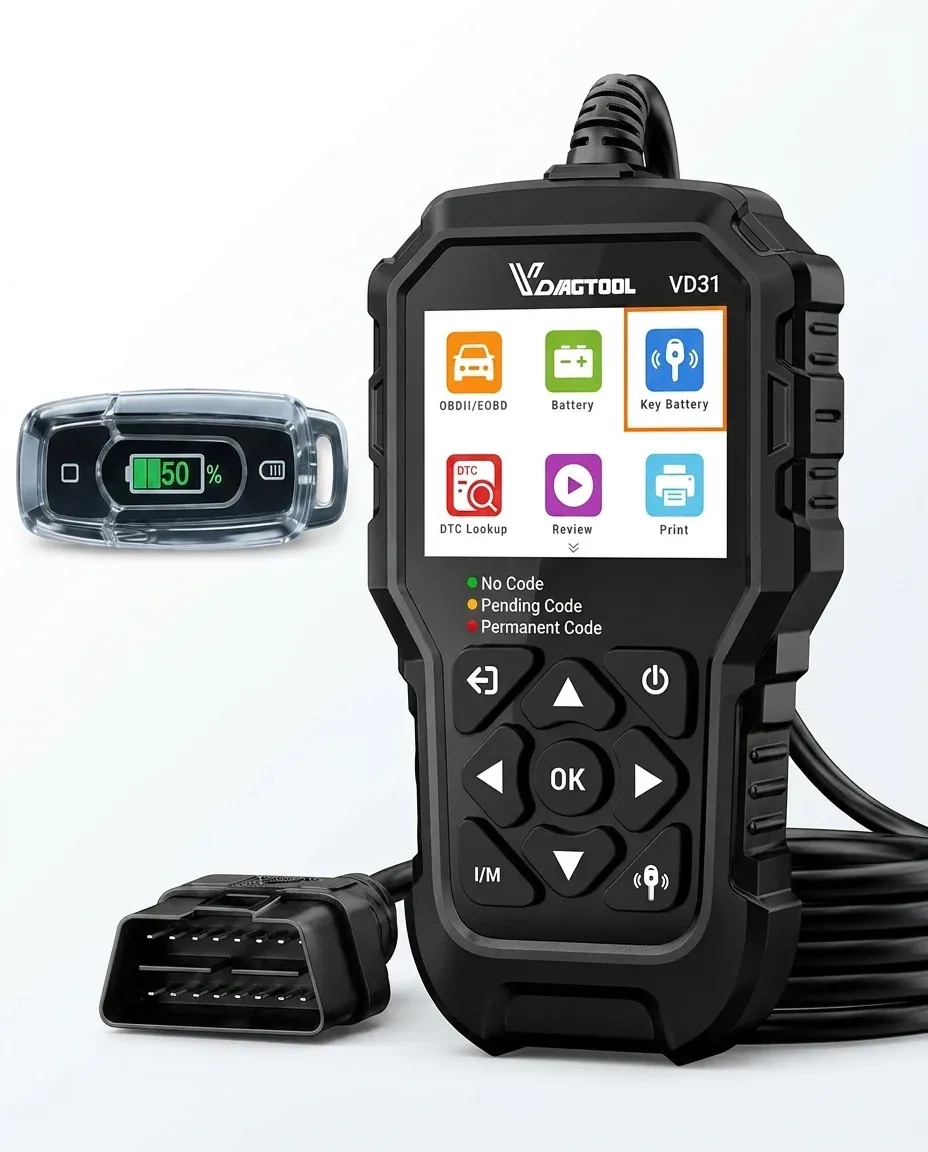
Short answer: a car key battery tester UK search can describe two different tools. A direct coin-cell tester checks the removed battery, while the ScanCar VD31's built-in key function listens for the fob's radio-frequency (RF) transmission and displays frequency and signal strength; it does not directly measure battery voltage.
If your key only works close to the car or responds intermittently, an RF check is a useful clue. It must still be combined with a controlled comparison, the spare key and—where appropriate—a direct battery check.
RF tester or direct coin-cell tester?
| Test type | What it checks | What it cannot prove |
|---|---|---|
| RF key-fob test | Whether a button press produces a detectable transmission, with frequency/strength information | The exact battery voltage, battery capacity or vehicle receiver health |
| Direct coin-cell test | The removed cell's electrical condition using that tester's method | Whether the fob buttons, circuit, programming or vehicle receiver work |
| Try the spare key | Whether the symptom follows one key | The precise failed component without further checks |
The distinction matters because “signal detected” and “battery healthy” are not the same claim. The existing key article blurred those categories; this guide keeps them separate.
How to make an RF key-fob check repeatable
- Use the product instructions to select the key-test function.
- Hold the fob close to the receiver at a consistent distance and orientation.
- Press the same button several times and note whether the frequency and strength display appears consistently.
- Repeat under the same conditions with the spare key, if available.
- If one key is consistently weaker or intermittent, inspect its battery and contacts using the vehicle handbook's battery-change procedure.
Do not invent a universal “good” strength number: fob design, distance, orientation and tester scale affect the reading. Repeatability and comparison are more useful than one isolated value.
Use the symptom pattern to choose the next check
- Shorter range or intermittent response on one key: compare the spare, then inspect or directly test the correct coin cell.
- No RF detected from one key: confirm the test setup and try another button; the battery, contacts, switch or fob circuit may need attention.
- Similar RF from both keys but the car ignores both: the vehicle-side receiver, antenna, pairing or locking system may require diagnosis.
- Dashboard says key battery low: follow the handbook and fit the exact specified battery; do not substitute by diameter alone.
If replacing the specified battery does not restore reliable operation, stop treating it as a battery-only problem. Damaged buttons, dirty contacts, lost synchronisation or a vehicle-side fault need a different check.
Handle button batteries as a safety item
Coin cells from car key fobs are small but not harmless. GOV.UK/OPSS button-battery guidance warns that swallowing one can cause severe internal burns and that “dead” cells can remain dangerous. Keep new and used cells secured away from children, follow the fob maker's opening procedure and recycle removed batteries promptly at a suitable collection point.
Use the exact battery type printed on the old cell or specified in the handbook. Fit it with the correct polarity and avoid bending contacts or forcing the case closed.
Where the ScanCar key test fits
The ScanCar VD31 combines its wired OBD2/EOBD code-reader functions with an RF key-fob test. The product instructions describe selecting “Key Test”, holding the fob near the device and pressing a button to display frequency and signal strength. At £75.36, the extra function is useful for the owner who wants one glovebox device, provided the RF result is interpreted honestly.
For engine warning lights rather than a remote-key symptom, use the car diagnostic scanner UK guide. Review the ScanCar VD31 product details.
FAQ
Can an RF tester prove that the coin-cell battery is healthy?
No. It proves only that a transmission was detected under the test conditions. A weak cell may still transmit nearby, and a direct battery test measures something different.
Why does the fob show a signal but the car still does not unlock?
The key may be transmitting while the vehicle has a receiver, pairing, antenna or locking-system problem. Compare the spare key and follow the vehicle handbook before seeking specialist help.
Should I test both the main key and the spare?
Yes. Repeat the same button, distance and orientation for both keys. A consistent difference is more informative than one isolated strength reading.
Will changing the car-key battery erase its programming?
That depends on the vehicle and key design. Do not rely on a universal answer; follow the battery-change and resynchronisation instructions in the owner's handbook.
Ready to take control of your car's health with ScanCar?
Shop Now — £75.36