Engine diagnostics · Read before you reset
A clearer first check.
Understand an engine warning, record the evidence and choose a compatible code reader. Practical UK guides to OBD2 checks and the limits of home diagnosis.
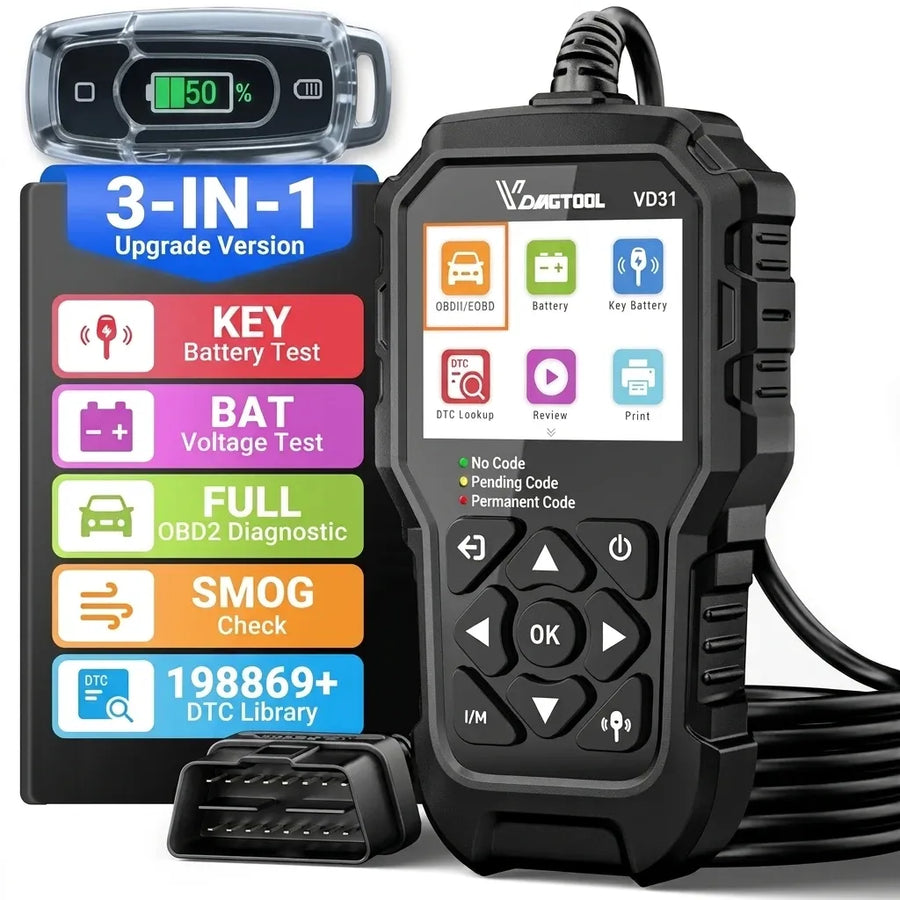
Choose by vehicle and job first.
For a UK-market car, confirm the exact model year, engine, original sales market and required controller. A generic 12 V OBD2/EOBD reader can collect supported engine/emissions evidence; that does not establish ABS/SRS, gearbox, service-reset or active-test coverage.
Check vehicle and protocol compatibility · Review the VD31 functions and limitations · Explore the current reader category.
Choose with confidence
Start with what matters.
Save codes and freeze-frame evidence
Investigate the fault before clearing
VDIAGTOOL VD31 OBD2 Reader
Confirm the vehicle, protocol and functions you need. Generic engine and emissions access does not establish ABS, airbag or all-system support. A key-fob RF check does not directly measure the coin-cell battery voltage. A code read does not repair a fault.
Check the current productScanCar guides
A useful place to begin.
Car Diagnostic Scanner UK: A Practical Buyer's Guide
Choose a car diagnostic scanner around your exact vehicle and the engine checks you need. Preserve codes and useful evidence, and understand the limits of home diagnosis.
Read the guide →Car Code Reader for Beginners: A UK No-App Guide
Start with a plug-in car code reader: read and record engine fault information before deciding what to do next. Clearing a warning does not repair the underlying fault.
Read the guide →Car Key Battery Tester UK: RF vs Coin-Cell Tests
Distinguish a key-fob radio-frequency test from a direct coin-cell battery test. Understand what the ScanCar VD31 key function can indicate and what requires a different measurement.
Read the guide →Readings and tool decisions
Find the next check for your question.
Start with the value or task you need. These guides distinguish supported engine observations from vehicle-specific service work, so you can decide whether a basic reader is enough.
Interpret the engine readings
- OBD Coolant Temperature: Check a Cold Reading Before Buying a Sensor
- Short and Long-Term Fuel Trim: What to Record Before Changing Parts
- OBD Oxygen Sensor Data: Voltage, Lambda or Current?
- MAF and MAP on a Code Reader: Different Measurements, Different Questions
- Why OBD Throttle Position Does Not Match the Accelerator Pedal
- Calculated and Absolute Engine Load: Why OBD Percentages Differ
- OBD Timing Advance Is Not a Cambelt or Timing-Chain Test
Check the information and the tool
- Code Reader Voltage or Battery Test? Know What Was Measured
- Fuel Rail Pressure on OBD: Check the PID and Units First
- OBD VIN Missing or Different: What a Reader Can and Cannot Verify
- Mode 06 Results: What an On-Board Monitor Test Can Tell You
- OBD Live Data Says N/A or Zero: Unsupported, Unavailable or Measured?
- Open Loop and Closed Loop on OBD: Read the State Before the Trims
- Diesel DPF Code Reading or Forced Regeneration: Different Tool Requirements
Choose the correct service capability
- Oil Service Reset or Engine-Code Clear? Choose the Right Operation
- Battery Registration After Replacement: Is a Code Reader Enough?
- Electronic Parking Brake Pad Changes: Confirm Service Mode Before Buying
- Car Will Not Start: Can an Engine Code Reader Check the Immobiliser?
- TPMS Warning: Engine Reader, Sensor Tool or Vehicle Reset?
- Secure Diagnostic Gateways: Check Tool Access Before Buying
- Misfire Code or Cylinder Counter? Ask What the Scanner Actually Shows
More diagnostic decisions
Choose the evidence for your next question.
Start with the value or task you need. These guides distinguish supported engine observations from vehicle-specific service work, so you can decide whether a basic reader is enough.
Choose the equipment and workflow
- Checking Petrol Emissions: OBD Reader or Exhaust Gas Test?
- OBD1 to OBD2 Adapter: Will It Make an Older UK Car Work?
- Four OBD Graphs or One Fast Reading? Choose the Useful Update Rate
- VD31 Playback and Printing: Check the Evidence Workflow Before Buying
- Can a 12 V OBD Reader Be Used on a 24 V Truck?
- OBD Extension Cable or Splitter: Checks Before Connecting a Reader
- Free Scanner Updates: Do They Include the Vehicle Function You Need?
Match the controller and service operation
- Automatic Gearbox Warning: Engine Codes or a Full TCM Scan?
- Air Conditioning Faults: What a Scanner Adds to the Diagnosis
- AdBlue or SCR Warning: Refill, Code Reading and Reset Are Different Jobs
- Steering-Angle Calibration: Why Clearing Codes Is Not the Same Task
- Diesel Injector Coding Is Not the Same as Reading Injector Fault Codes
- Towbar Electronics: Will an OBD Reader Code a Trailer Module?
- Can an OBD Scan Verify Mileage? Keep Distance Fields Separate
Interpret the reported engine data
- Commanded EGR and EGR Error: What Do the Two OBD Values Mean?
- EVAP Purge Percentage Is Not a Fuel-Vapour Leak Test
- Catalyst Temperature on OBD: Reported, Estimated or Measured?
- OBD Fuel Rate and MPG: What the Display Can Really Compare
- Engine Run Time and Warm-Up Counters: Do Not Read Them as Vehicle History
- Calibration ID and CVN on OBD: What Do They Prove About ECU Software?
- Oil Temperature or Coolant Temperature: Choose the Right Warm-Up Reading