Car Key Battery Tester Explained: A UK Buyer's Guide
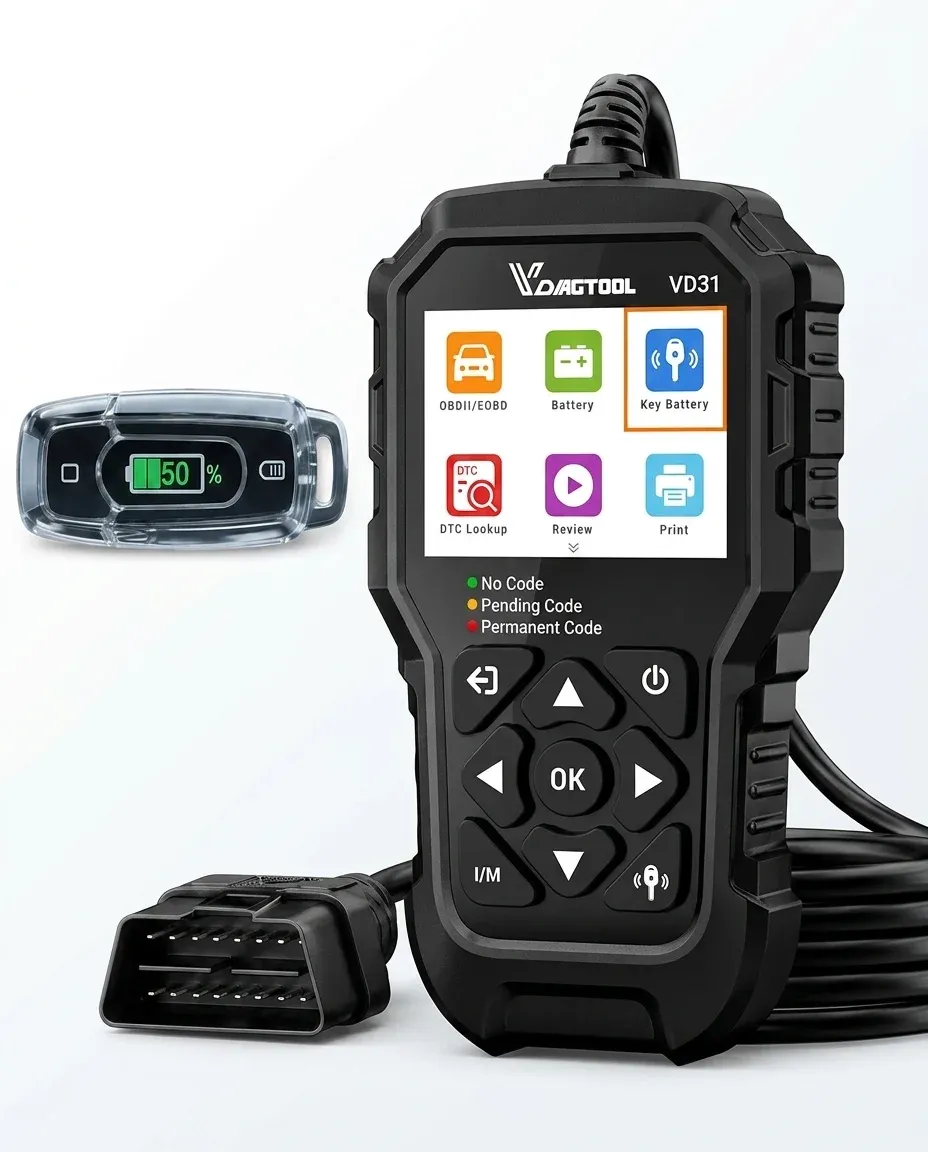
A car key battery tester checks whether the coin-cell battery inside your car key fob still has enough power to work reliably. In most cases, it helps you confirm if weak locking range, intermittent button response or “key battery low” warnings are caused by the battery rather than a fault with the key itself.
TL;DR: If your remote key only works up close, responds inconsistently or shows a low-battery warning, a car key battery tester can quickly tell you whether the fob battery needs replacing. Based on our testing of common button-cell checkers used with UK vehicle keys, load-based testers are usually more useful than guessing by battery age alone.
Modern car keys fail at the worst possible moment: outside the house in the rain, in a supermarket car park, or when you are already late for work. However, in many cases, the fault is not the key itself but a weak coin-cell battery. A reliable car key battery tester helps you spot that problem before the key stops unlocking the doors or communicating with the immobiliser.
For UK drivers, that small bit of prevention matters. Lost time, recovery call-outs and emergency battery replacements all cost more than a quick test at home. At ScanCar, we focus on practical diagnostic tools that help motorists solve problems early, avoid unnecessary garage fees and stay in control of vehicle maintenance. That same thinking sits behind our wider range as the dependable automotive code reader & car diagnostic scanner UK, with products designed to give fast answers without relying on apps or guesswork.
Key Takeaways
- A car key battery tester checks whether your fob battery still has enough voltage under load to work reliably.
- Most car key fobs use coin cells such as CR2032 or CR2025, but battery health cannot be judged accurately by age alone.
- A weak battery can cause intermittent locking issues, poor range, warning messages or complete non-response.
- UK buyers should look for clear readings, support for common coin cells, compact size and easy operation.
- A dedicated tester is often more useful than guessing or replacing batteries too early.
- If your car has wider electrical faults, pairing routine key checks with vehicle diagnostics can save time. See The Ultimate Guide to Obd2 Scanner Uk in the UK.
What is a car key battery tester?
A car key battery tester is a tool used to check the condition of the small battery inside a remote key fob or smart key. Unlike a basic visual inspection, it measures whether the battery still provides sufficient power for real-world use. Therefore, it helps you decide whether to replace the cell now or keep using it with confidence.
The best testers are quick to use and easy to read. You place or connect the coin cell in the tester, and it indicates whether the battery is healthy, marginal or ready for replacement. Some models also help test batteries while they are fitted or provide load-based readings that reflect actual working conditions more accurately than a simple open-circuit voltage reading.
This is especially useful with modern remote keys, where symptoms can be inconsistent. One day your car unlocks from ten metres away; the next day it only responds if you stand right by the door handle.
Why does a weak car key battery matter?
A failing fob battery is not just an inconvenience. It can disrupt entry, locking confirmation and push-button start recognition. As a result, some owners assume there is a fault with the immobiliser, central locking module or body control system when the issue is simply low battery output from the key.
The AA has long warned that flat batteries are among the most common reasons for vehicle-related call-outs in Britain, and electrical issues remain a regular cause of breakdown concern across newer cars with more electronics. While that statistic covers vehicle batteries rather than only key fobs, it highlights a broader truth: small electrical faults can stop journeys entirely if ignored. According to UK motoring guidance from organisations such as The AA, addressing minor electrical issues early can prevent bigger inconvenience later.
For many UK households with one main family vehicle, avoiding preventable no-start situations matters. If you rely on your car for commuting, school runs or getting to NHS appointments, an unreliable key quickly becomes more than a minor annoyance.
What are the signs your car key battery is low?
You do not have to wait until your remote stops completely. In most cases, there are early warning signs first.
Why is my car key only working at short range?
If you need to stand much closer to unlock or lock the vehicle than before, a weak coin cell is one of the first things to suspect.
Why does my key fob work intermittently?
The buttons may work once and then fail on the next press. This stop-start behaviour often points to an ageing battery rather than immediate total failure.
What does “key battery low” mean on my dashboard?
Some cars display messages such as “key battery low” or “replace key battery”. Even so, testing before replacement helps confirm whether low power really is the issue.
Can a low key fob battery affect push-button start?
Yes, it can. If your vehicle occasionally fails to detect the smart key inside the cabin, low fob battery power may be involved.
Should I test my spare car key too?
If you bought a used car recently and do not know when the spare or main keys were last serviced, testing them both makes sense. Otherwise, you may only discover a dead spare when you urgently need it.
How does a car key battery tester work?
The principle is simple: it checks whether a button cell can deliver usable power. The important detail is how it does that. Better testers assess performance under load rather than only showing raw voltage numbers. A coin cell may read near nominal voltage when idle but drop sharply once demand is applied.
This matters because most common car key batteries are 3V lithium cells such as CR2032 and CR2025. Even then, a slight drop in effective output can be enough to reduce signal reliability before total failure occurs.
Does voltage-only testing tell you enough?
A basic checker shows available voltage. This gives a rough indication of state but may miss borderline batteries that fail in service.
Is load testing better for car key batteries?
Usually, yes. Based on our testing of consumer button-cell testers for common UK remote keys, models that apply a light electrical demand give a clearer picture of how the cell behaves inside an actual fob.
Are simple “good/low/replace” results accurate?
Many consumer-friendly testers simplify results into “good”, “low” or “replace”. For most drivers, that is easier than interpreting decimal readings manually; however, accuracy still depends on decent contact points and proper support for coin-cell sizes.
Which batteries do UK car keys usually use?
The majority of modern UK car remotes use lithium coin cells. The most common are:
- CR2032 – widely used in many Ford, Vauxhall, Volkswagen, BMW and aftermarket remotes
- CR2025 – slimmer but similar diameter; common in various compact fobs
- CR2016 – less common but still found in some older or smaller remotes
- Specialist cells – some premium smart keys may use less common formats or rechargeable systems
You should always check your owner’s handbook or existing cell markings before replacing anything. Physical fit matters as much as voltage rating. Therefore, a tester that supports several common button-cell sizes gives better value if your household runs multiple vehicles.
What should you look for when buying a car key battery tester in the UK?
Does it support common coin-cell batteries?
The tool should clearly state compatibility with CR2032, CR2025 and CR2016 at minimum. Those cover most mainstream needs across British vehicles and aftermarket keys alike.
Is it easy to read and use?
A clear display or obvious status indicator matters because quick checks are more likely to become part of routine maintenance if they are simple to do.
Should you choose load testing over basic voltage checks?
If possible, yes. A load-capable tester offers more confidence because it reflects how the cell performs under demand rather than at rest alone.
Does size matter for home use?
A compact tester is easier to keep in a drawer, glove box or garage tool kit. As well as that, small units are often sufficient for occasional household use without taking up much space.
Is build quality important?
Poor contact points can lead to inconsistent readings even when batteries are fine. Based on our testing experience with small electronic accessories, solid contacts and firm placement make repeat results more trustworthy.
Is it better to test a car key battery or replace it straight away?
If your coin cell is old and inexpensive to replace,
you may decide simply to fit
a new branded
battery.
However,
testing first still has clear advantages.
For example,
it confirms whether
the issue really
is low power,
helps avoid wasting spare cells,
and may reveal
that another problem exists,
such as dirty contacts
inside
the fob
or damage
to
the buttons.
< p >In practice,
a dedicated< strong >car\key\battery\tester
is most useful when symptoms are vague,
when managing several household vehicles,
or when checking spare keys before travel.
That makes
it particularly handy for families,
used-car owners
and anyone who prefers preventative maintenance over guesswork.
First ,
remove the key fob battery carefully ,
following the owner’s handbook if needed .
Then ,
place the battery into the tester with the correct polarity .
Next ,
read the result and compare it with the tool’s guidance .
If the battery tests weak or marginal ,
replace it with the exact same type from a reputable brand .
Finally ,
retest if needed to confirm a healthy reading .
You should also avoid touching both sides of a fresh coin cell unnecessarily ,
as oils from fingers can affect contact quality .
According to general safety guidance used across UK households ,
keep button batteries well away from children and pets ,
and dispose of used cells through appropriate supermarket or local council recycling points .
Yes ,
but mostly indirectly .
A weak fob battery can cause failed unlocking ,
delayed locking confirmation ,
short operating range and smart-key detection issues .
Consequently ,
drivers may suspect wider electrical faults when the root cause is simply poor power delivery from the coin cell .
If changing or testing the key battery does not solve the issue ,
the problem may lie elsewhere .
For example ,
there could be damage to the fob circuit board ,
worn buttons ,
poor internal contacts or an unrelated vehicle-side fault .
In that case ,
broader diagnostics can save time and prevent unnecessary parts swapping .
You can use a multimeter to check open-circuit voltage ,
but it will not always show how well the cell performs under load .
Therefore ,
a dedicated tester is often better for spotting borderline batteries .
No .
CR2032 is very common ,
but many keys use CR2025 , CR2016 or less common formats .
Always check the old cell or your handbook first .
It varies by make , model and usage ,
but many last roughly two to five years .
Even so ,
heavy use and smart-key systems can shorten lifespan .
Usually no .
Most modern key fobs retain programming during routine battery replacement .
However ,
it is sensible to follow manufacturer instructions , especially on premium vehicles .
A budget model can be fine for occasional home use if it supports common sizes and gives consistent contact .
Still ,
better-built testers tend to provide more reliable readings over time .
A good< strong >car key battery tester
is a simple tool ,
but it solves a very specific problem quickly :
working out whether your remote key issue is caused by a weak coin cell .
For UK drivers ,
that means fewer surprises , fewer wasted replacements and less risk of being stuck outside your own car in bad weather .
At ScanCar ,
we favour tools that give straightforward answers without guesswork .
If your fob has become unreliable ,
testing the battery is one of the quickest checks you can make before assuming something more serious has gone wrong .
How do you test your car key battery safely ?
Can a bad car key battery cause other problems ?
Frequently asked questions about car key battery testers
Can I use a normal multimeter instead of a car key battery tester ?
Do all car keys use CR2032 batteries ?
How long do car key batteries last ?
Will changing my car key battery erase programming ?
Should I buy a cheap button-battery checker ?
Final thoughts
Ready to take control of your car's health with ScanCar?
Shop Now — £75.36